Origins - The Legend of Bodhidharma
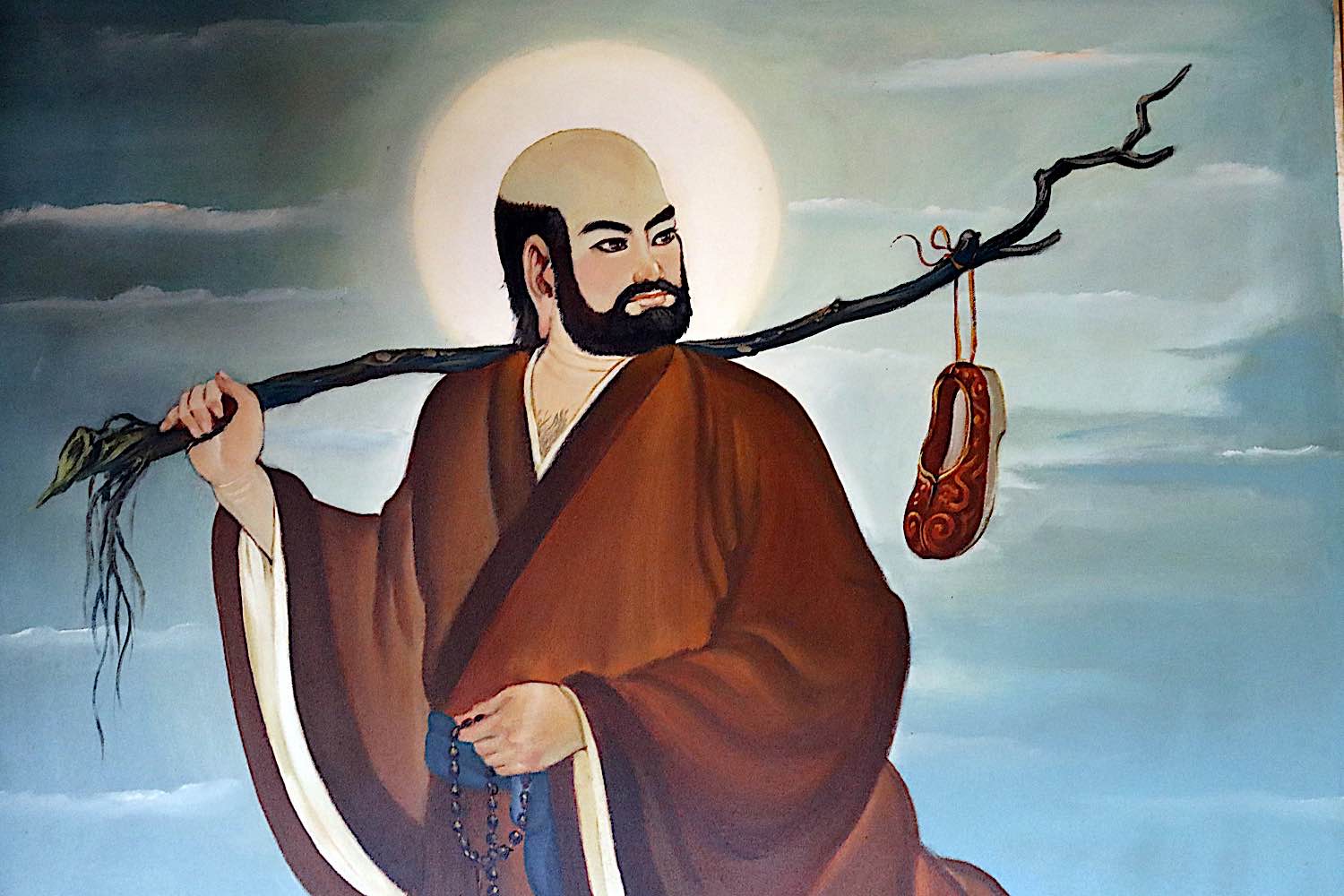
There are numerous legends and myths about the origins of Wing Tsjun. The fact is that because of the lack of scientific evidence, it has always been really hard to track down the people and their contribution to the style at a certain point in time. Let's have a look at the bigger picture now. The creator of all Chinese martial arts and the founder of Chinese Zen Buddhism is thought to be the Indian monk Bodhidharma (440-528). He is also thought to be at the origin of "Siu Lam Kung-Fu" (Shaolin Kung Fu). Bodhidharma was born in Kanchipuram, and he trained in the art of "Kuttu Varisai". In 480 AD, he left his country to travel to China, where he settled down by the year 523 in the northern province of Henan. He studied at the famous Shaolin Monastery, and it is there that he is said to have laid down the core principles of certain Chinese martial arts, although there is no actual evidence left.
Myth and Reality - The Destruction of the Monastery
According to a more popular legend, the Wing Tsjun style was created in a Southern Shaolin Monastery that doesn't exist anymore. It is said that a nun called Ng Mui used to live there during the Qing Dynasty (1662-1722).
Ng Mui was a master in many martial arts, and she was searching for a style that would enable women, who during the Civil War were often victims of abuse and violence, to protect themselves against the physically stronger male attackers. She was also looking for a way to fight against practitioners of the Shaolin style that was very strong and popular at the time. The Shaolin monks were very famous during the Qing Dynasty, and because of their raising influence, the Emperor Kangxi started worrying about his power and decided to burn down the monastery and kill everyone in it.
His plan didn't succeed because the monks were able to fight off his henchmen.
The legend continues with the story of betrayal of the monastery from inside, by a clerk called Chan Man Wai, who, driven by the desire to get a name for himself, together with Ma Ning Yee and others, set fire to it and killed almost all its inhabitants.
Ng Mui, the abbot, Master Chi Sim, and most of the students, Master Pak Mei, Master Fung To Tak, and Master Mui Hin, managed to survive. They were the leaders of the five Shaolin Styles and were also called "The Five Elders".
The authenticity of this story is still to be argued. According to evidence from a calligraphy piece of that time, Kangxi was a supporter of the northern Shaolin monastery.
The Nun and her female student
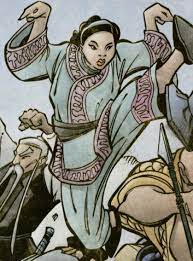
After the monastery was destroyed, the survivors had to split in order to avoid capture and persecution. Master Chi Sim hid his identity and started working as a chef on a "Red Boat". "Red Boat" was the name given to the transport boats for opera groups because they were normally painted in red and decorated with colorful flags.
The nun Ng Mui settled at the Temple of the White Crane, by the mountain Tai Leung, where she was able to continue practicing her martial arts. In the neighboring village, she met a girl called Yim Wing Tsjun and her father Yim Lee, as they were selling tofu at the market. Both of them had to run away from home in the province of Kwantung because of the father's dangerous involvement in a court case (presumably innocent).
According to legend, the style owes its name to the girl Yim Wing Chun.
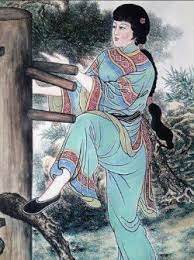
The young Yim Wing Chun attracted the attention of a well-known troublemaker in the village called Wong, who proposed to her, even though she had been promised since her childhood to the salt trader Leung Bok Chau from the province of Fujian. Wong sent someone to give her an ultimatum and threaten her and her father with violence if they didn't obey.
Being their regular customer, Ng Mui noticed that they looked very worried and concerned until, one day, Yim Wing Chun confessed to her about their problems with Wong.
She decided to help them, but because she couldn't afford to disclose her identity by challenging Wong to a fight herself, she brought Yim Wing Chun to her style.
In only three years of private teaching, Yim Wing Chun had managed to master the new style of martial arts and left the Temple of the White Crane to go back to her father. As soon as she returned, Wong threatened her again, but this time she challenged him to a fight.
He was so sure of victory and ended up being very surprised and disappointed as she put him down to the ground straight away. Yim Wing Chun continued her training with her master Ng Mui and later married Leung Bok Chau. In the following years, she worked on refining and simplifying the principles of the art. Due to her contribution to the style, the name originated from her, even though it was Ng Mui who created it.
After significant improvements to the style, Yim Wing Chun taught it to her husband.
Leung Bok Chau had previous knowledge from different martial arts, so it was easy for him to learn the new style. He was very impressed by his wife's skills and knowledge and learned the style quickly but with care.
Also, Leung Bok Chau delivered the style further to his uncle Leung Lan Kwai. Unfortunately, there isn't much evidence about Leung Lan Kwai's contribution to the style.
According to some sources, he was thought to be a scholar from Guangzhou, others describe him as an osteopath from Foshan or Zhaoging.
Leung Lan Kwai brought the style to the theater boats. He was thought to be either part of the crew or just a good friend of several of the actors. Unfortunately, there are hardly any mentions of him in the stories and fables of that time, which makes his existence very doubtful.
The legend says that Leung Lan Kwai started teaching Wong Wah Bo and Leung Yee Tai, but in reality, it was Leung Bok Chau who actually taught them.
Wong Wah Bo worked as a rower on one of the opera ships. Legend states that he was very strong and fit. It is said that one of Wong's chores on the boat was to push it away from the shore by using a long pole. He would also use his long pole for practicing martial arts.
During his work on the so-called "red junks," he met the actor Leung Yee Tai on the ships, who was a member of the opera crew and very often played female roles. Leung was fascinated by his colleague's skills, and Wong Wah Bo also admired Leung's skills. They decided to exchange knowledge. Wong Wah Bo taught Leung Yee Tai the "Lok Dim Poon Kwun" (six and a half point long pole techniques) and in exchange, got taught the "Bart Cham Dao" (eight ways of the cutting butterfly knives) and the empty-handed fighting.
Together they worked to improve the style and modified the long pole techniques according to the principles of Wing Tsjun, in order to make them more efficient.
So, during this so-called "Red Junk Period," weapons were added to the style. The next people who learned the style from the two masters also brought it from the boats to land.
Doctor Leung Jan (1826-1901) was a herbal doctor and pharmacist. He understood that the soft and the hard elements of Wing Tsjun needed to be put together and practiced in harmony. He started practicing Wing Tsjun with the opera members in the 1840s. The assumption is that while Leung Jan was helping out on the red Junks, he received tuition from Leung Yee Tai. This possibly happened between 1840 and 1850.
After the death of his father, Leung Jan had to go back and run his pharmacy. He continued his study of Wing Tsjun under Wong Wah Bo's guidance. It was in this period that he, together with Wong Wah Bo, developed the three empty-handed forms that were meant to help in delivering the style.
Leung Jan earned himself the title "Wing Tsjun Kung Fu Wong" or "The King of Wing Tsjun Kung Fu" after he had defeated over 300 challengers. He was the first to defeat, with his Wing Tsjun, fighters from different martial arts.
Chan Wa Shun, also known as Wah the money changer (1836-1909), is the next character important to the lineage. He was Dr. Leung Jan's student and today best known as Yip Man's teacher, who in turn is known to be Bruce Lee's teacher. Chan's money-changing shop was right next to Leung Jan's pharmacy. Over the years, his business had flourished, and he acquired a lot of wealth and influence. He as well had some experience in martial arts before he started training in Wing Tsjun.
At that time, Leung Jan was having a few private students, including his sons, Leung Chun and Leung Bik, and the so-called "Wooden Man Wah".